
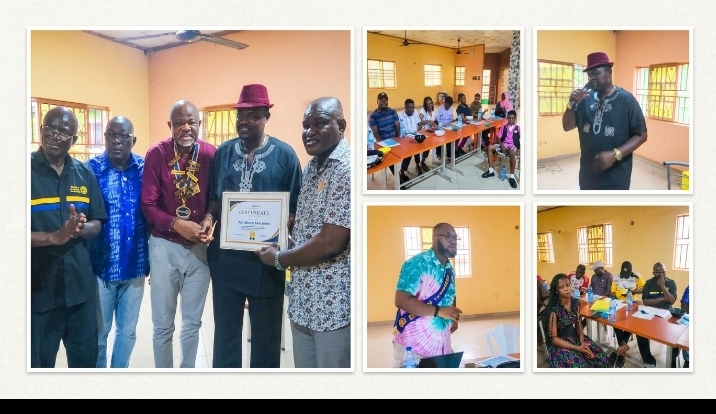
The Rotary Club of Ibadan Oritamefa has hosted a lecture examining the gains of the Academic Staff Union of Universities (ASUU) struggles on Nigeria’s tertiary education system, with a University of Ibadan don, Prof. Ademola Kabir Aremu, calling for greater attention to the issues behind university strikes and sustained investment in education.
According to the President of the Rotary Club of Ibadan Oritamefa, Rotarian Ojo Jimoh, the lecture formed part of the club’s commitment to promoting basic education and literacy and creating awareness about issues affecting the development of Nigeria’s education sector, in line with Rotary International’s September focus on Basic Education and Literacy.
The lecture, held during the club’s fellowship on Thursday, September 17, 2026, was titled “The Benefits of ASUU Struggle on the Nigerian Tertiary Education System.” It was delivered by Prof. Aremu , who took participants through the history of tertiary education in Nigeria, the evolution of ASUU and the major issues that have shaped the union’s struggles over the years.
Aremu explained that tertiary education is central to national development, human capital development, research and innovation, stressing that Nigerian universities must be adequately funded and positioned to compete globally.
He traced the history of tertiary education in Nigeria, including the development of the country’s early universities and academic unions. He explained that the struggles of academic unions have historically centred on issues including members’ welfare, university funding, academic freedom, university autonomy and improved conditions of service.
Why ASUU Embarks on Strikes
Speaking on the reasons for ASUU’s industrial actions, Aremu said the union does not embark on strikes without first exhausting other avenues.
According to him, ASUU engages government through dialogue, negotiations and lobbying, with strikes serving as a last resort when agreements reached with government are not implemented.
He said the union’s major demands have included proper funding of universities, improved salaries and conditions of service, research support, academic freedom and autonomy, as well as measures to address brain drain.
Aremu said Nigerian academics need globally competitive conditions of service to discourage migration and make the country’s universities attractive to foreign scholars and students.
He said: “People don’t look at the cause, they see the effects of the strike, but nobody wants to care when things are not alright.”
The lecturer argued that government and other stakeholders should address the underlying problems confronting universities rather than focusing solely on the disruption caused by industrial actions.
He also noted that agreements freely entered into between government and ASUU should be honoured, pointing out that failure to implement such agreements often creates the circumstances for fresh disputes.
This is another opportunity to own a faster-loading website to expand your business and take it digitally online. Meet the best website designer/master coder for any kind of website. Contact them now it is affordable Chat now: 09077260922
Gains of ASUU Struggles
According to Aremu, ASUU’s sustained struggles have contributed to several developments in Nigeria’s university system, including increased attention to tertiary education funding, improved classrooms and laboratories, NEEDS Assessment interventions, better conditions of service and the development of funding mechanisms such as the Education Trust Fund, which later became the Tertiary Education Trust Fund (TETFund).
He said the struggle for improved university funding was necessary because inadequate funding remains one of the major challenges confronting Nigerian tertiary institutions.
Aremu also raised concerns about the proliferation of universities without adequate funding, warning that establishing more institutions without providing the necessary infrastructure, lecturers and learning facilities could undermine the quality of graduates.
He called for adequate funding of existing institutions and the release of funds promised for university development.
The lecturer further discussed academic freedom and university autonomy, advocating a system in which universities are properly governed through committee structures and allowed sufficient independence in academic matters, including curriculum development.
He also examined the university admission process, including the role of the Joint Admissions and Matriculation Board (JAMB), and discussed the importance of Post-UTME as an additional mechanism for universities to assess prospective students.
Aremu said the fight for quality tertiary education should not be left to ASUU alone, urging students, parents, civil society organisations, professional bodies, labour organisations, political leaders and other Nigerians to take ownership of the struggle for a better university system.
He also called for leaders who would take education seriously and urged Nigerians not to sell their votes, stressing that education should be treated as a national development project.
He, however, commended the present administration for what he described as its prompt engagement with ASUU and the agreements reached with the union, noting that uninterrupted tertiary education under the administration had become one of the issues being highlighted by the government.
Rotary President: Lecture Was Impactful and Timely
President of the Rotary Club of Ibadan Oritamefa, Rotarian Ojo Jimoh, described the lecture as “explosive,” “engaging,” “impactful” and “timely.”
Jimoh said the lecture was organised as part of the club’s September focus on Basic Education and Literacy and had provided participants with a better understanding of the reasons behind ASUU’s struggles while helping to correct misconceptions about the union’s industrial actions.
He said: “The lecture is impactful, timely. We commend the presenter and this government for ensuring that there is uninterrupted tertiary education since they came on board.”
The Rotary president said the club was particularly interested in the subject because education remains one of Rotary’s areas of focus.
He urged other organisations to support education, describing it as the bedrock of national development.
Jimoh also appealed to Nigerians to take their civic responsibilities seriously, particularly during elections, and to vote for leaders who would prioritise education and national development.
Participants Commend Lecture
The lecture was attended by Rotarians, Rotaractors, secondary school students and other members of the public, who commended Prof. Aremu for what they described as an eye-opening presentation.
Some participants said the lecture had broadened their understanding of ASUU’s history, demands and struggles, noting that they were now better informed about the issues behind university strikes and the gains associated with the union’s sustained advocacy for improved tertiary education in Nigeria. The participants also commended the Rotary Club of Ibadan Oritamefa under the leadership of Rotarian Ojo Jimoh for organizing the lecture.




Leave a Reply