
-
Poverty, Organ Shortage and a Growing Underground Market in Nigeria
Across Nigeria, allegations of young people surrendering their kidneys for quick money are raising fresh concerns about the deadly intersection of poverty, unemployment, financial hardship, organ shortages and human trafficking.
What may appear to offer temporary financial relief can leave victims with permanent health complications, psychological trauma, reduced quality of life and, in severe cases, death.
Recent cases reported in Abuja, Nasarawa, Lagos, Ogun and Delta have exposed a disturbing question: what is driving vulnerable Nigerians to surrender their kidneys and other organs for money?
The case of Samuel Ezekiel has brought the issue into sharper focus. Ezekiel says he agreed to have his kidney removed in April after a friend introduced him to the deal. He reportedly spent about a week recovering in hospital and received approximately ₦1.7 million.
The money, however, was quickly spent on phones, power banks, hotel accommodation and other expenses.
His case became public after he approached VeryDarkMan’s centre with medical evidence indicating that his left kidney was missing.
The allegations have since raised wider questions about whether vulnerable young Nigerians are being recruited into an underground organ-trafficking market — and who ultimately profits from it.
A Crime That Is Difficult to Measure
There is currently no reliable national database showing how many Nigerians have illegally sold or been trafficked for their organs.
That makes the true scale of the problem difficult to establish.
Organ trafficking is a hidden crime. Victims may be recruited privately, procedures may take place in legitimate-looking medical facilities, payments may pass through intermediaries, and victims may be reluctant to report what happened.
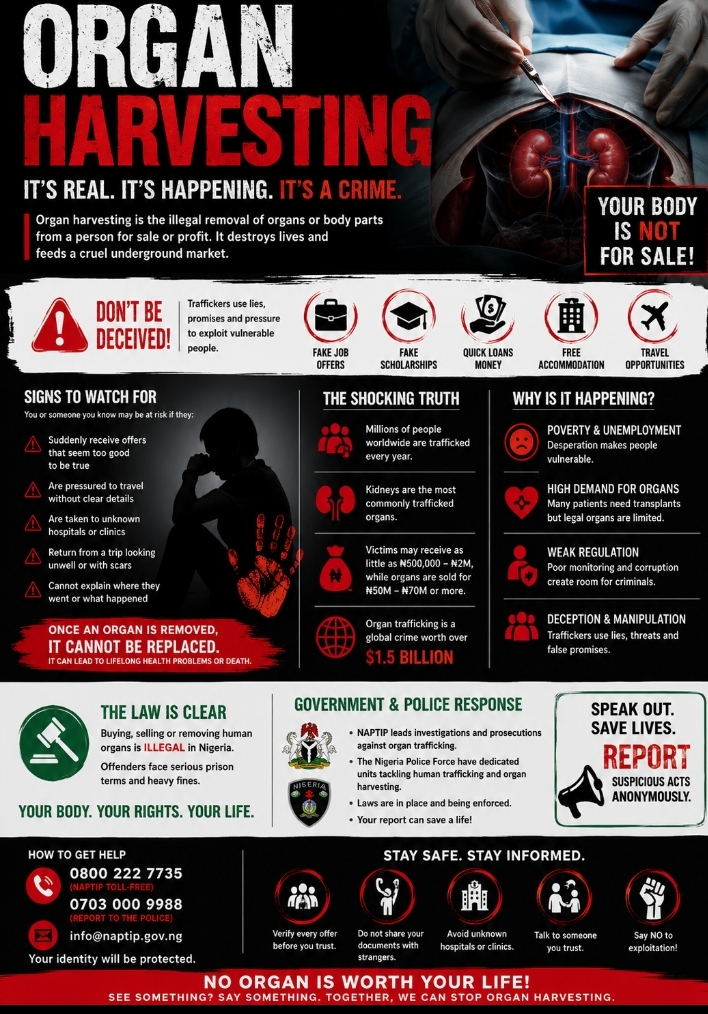
NAPTIP and researchers have identified socioeconomic vulnerability, poverty, unemployment, weak enforcement and demand for organs as factors that can create an environment for exploitation.
Recent Cases Raise Concern
Samuel’s case is not the only recent allegation.
In 2024, NAPTIP commenced what it described as Nigeria’s first prosecution centred on alleged illegal kidney harvesting involving Alliance Hospital in Abuja.
NAPTIP alleged that three young men — including two teenagers — had been procured for kidney removal. The defendants pleaded not guilty, and the allegations remain subject to the judicial process.
More recently, police investigations have also focused on alleged organ harvesting and human trafficking in Nasarawa and Delta, while other allegations have emerged in Lagos and Ogun.
In August 2026, the Nigeria Police Force announced the arrest of four suspects in connection with an alleged organ-harvesting and human-trafficking network in Nasarawa State. Two of the suspects were reportedly medical practitioners.
The allegations against the suspects have not been established in court.
The VeryDarkMan Investigation
The issue gained further national attention after Samuel Ezekiel’s account.
Marshall Abubakar, a lawyer working with VeryDarkMan, alleged that more than 10 young Nigerians could have fallen victim to an illegal kidney-harvesting network.
He also alleged that kidneys obtained from vulnerable people could be resold for tens of millions of naira.
These claims have not been independently established in court and should therefore be treated as allegations.
VDM later said the friend who allegedly introduced Ezekiel to the procedure had also lost a kidney. He further alleged that the friend had previously sold his own kidney for ₦7 million.
If established by investigators, the claim could point to a disturbing recruitment pattern in which former victims themselves become recruiters.
Why Would Anyone Sell a Kidney?
The answer may go beyond greed.
For some vulnerable people, desperation can overpower fear.
Nigeria’s economic difficulties have placed enormous pressure on young people dealing with unemployment, rising living costs, debt and limited opportunities for stable income.
To someone struggling to survive, a few million naira may appear to be a life-changing opportunity.
But an organ cannot be replaced simply because the money has been spent.
The immediate financial benefit may disappear within months or even weeks, while the consequences of losing an organ can potentially remain for the rest of the person’s life.
The Demand Behind the Trade
There is another side to the equation: demand.
People suffering from kidney failure need transplants, but the supply of legally donated organs is limited.
Where there is a large gap between demand and legitimate supply, criminal brokers can attempt to exploit vulnerable people.
The result can become a highly unequal chain in which the person who gives up the organ receives relatively little, while intermediaries and other participants allegedly make much more.
Is This a Nationwide Trend?
It would be premature to describe kidney selling as a nationwide trend with certainty because Nigeria does not have a dependable state-by-state database documenting illegal organ sales.
However, recent reported cases and investigations involving Abuja/FCT, Nasarawa, Lagos, Ogun and Delta, among other locations, have prompted increasing concern.
The absence of comprehensive statistics does not mean the problem does not exist. It means the country does not yet know its true size.
Government and Police Response
Nigeria has laws prohibiting the commercialisation of human organs, while trafficking legislation provides criminal penalties for trafficking people for organ removal.
NAPTIP has investigated and prosecuted alleged organ-trafficking cases and has warned about increasingly sophisticated recruitment methods, including the use of social media and deceptive offers.
The Nigeria Police Force has also stepped up investigations, including the recent Nasarawa arrests.
Lagos State has separately enacted the Lagos State Organ Harvesting Prohibition Law 2024, aimed at criminalising the illegal removal, sale and trafficking of human organs.
But enforcement remains a major challenge.
Arrests alone cannot dismantle an organised market if recruiters, medical facilitators, financiers, intermediaries and eventual buyers are not identified.
What Is Driving the Problem?
Several factors appear to be converging:
Poverty and unemployment: Financial desperation can make a large immediate payment appear irresistible.
Demand for kidneys: Patients requiring transplants create demand that can be exploited where legitimate organ supply is inadequate.
Weak regulation and enforcement: Criminal networks can thrive where monitoring and prosecution are ineffective.
Youth vulnerability: Young people facing unemployment, debt and limited opportunities may be easier targets for recruitment.
Social media: Traffickers can use fake jobs, loans, scholarships and other promises to approach potential victims online.
Medical expertise: Organ removal requires specialised medical knowledge, raising questions about how alleged criminal networks gain access to medical personnel and facilities.
Profit: The alleged difference between what vulnerable donors receive and what organs may ultimately command creates a powerful financial incentive for traffickers.
The Bigger Question
Samuel Ezekiel’s story should not be viewed simply as the story of a young man who made a poor financial decision.
It raises questions about an entire ecosystem.
Who recruited him?
Who arranged the operation?
Who performed the procedure?
Who paid him?
Who received the kidney?
Who ultimately profited?
And perhaps most importantly:
How many other Nigerians have lost organs without ever reporting what happened?
Until those questions are answered, it will remain difficult to determine whether Nigeria is dealing with isolated criminal cases or the emergence of a much larger underground organ market.
For now, the available evidence points to a serious but poorly measured problem — one in which economic desperation creates vulnerability, medical demand creates a market, and alleged criminal networks exploit the gap between the two.
The challenge for government and law-enforcement agencies is therefore not merely to arrest those allegedly removing kidneys.
It is to dismantle the entire chain — from recruitment and transportation to medical procedures, financing, transplantation and the eventual buyers — while protecting victims who may initially have believed they were simply accepting an opportunity to survive.
Related Articles:




Leave a Reply